 Aroma Tranquility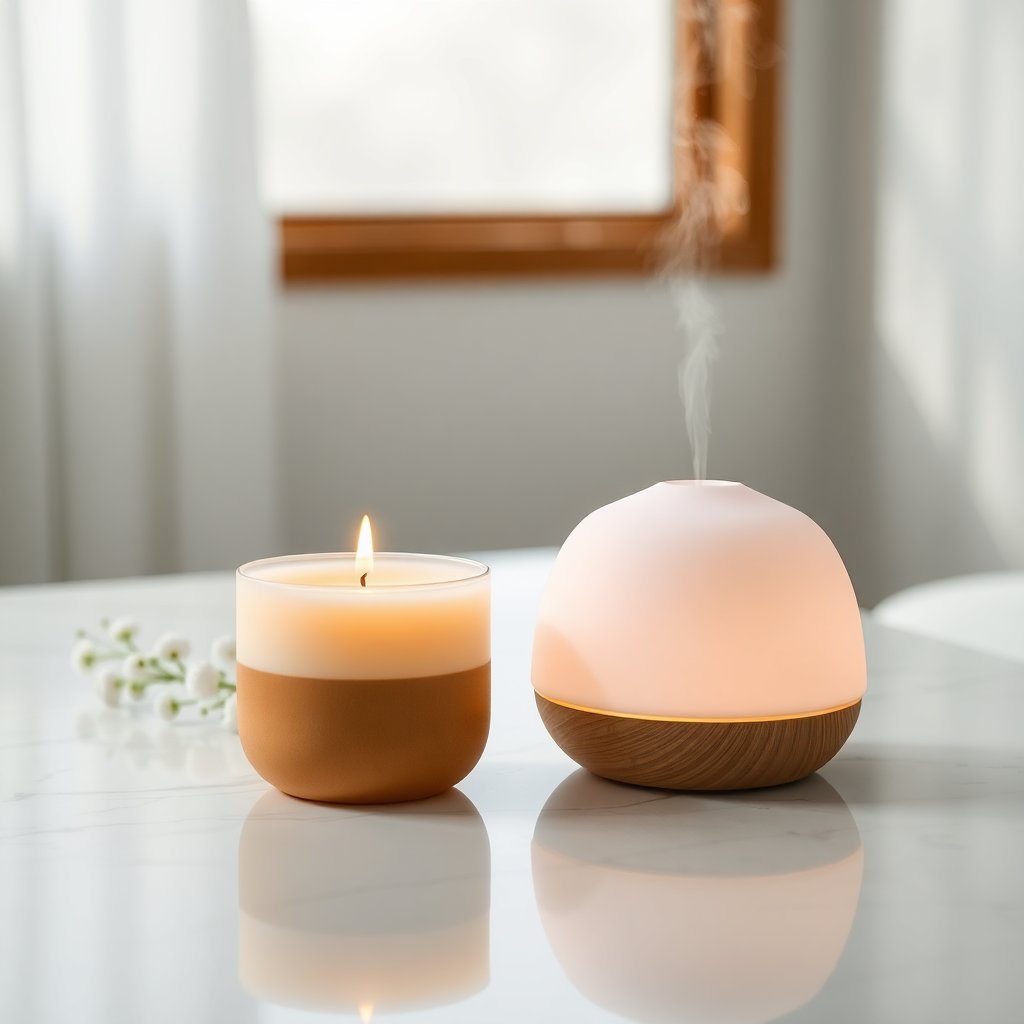
If you're new to aromatherapy, the candle vs. diffuser question comes up immediately. They both smell good — so what's the actual difference, and does it matter?
The short answer: yes, it matters, and most people end up wanting both for different reasons.
Let's break it down honestly, so you can make the right choice — or decide you need both.
What Candles Do Best
A candle is an experience. The flame, the warmth, the way the light moves — it's atmospheric in a way that a diffuser simply isn't. When you light a candle, you're signaling something: the workday is over, the bath is running, company is coming.
The best candles also have complex, blended scents that are hard to replicate with single essential oils. A good bergamot-fig-amber candle from Voluspa isn't just bergamot, fig, and amber — it's a perfumer's composition, and it smells like one. The fragrance is designed to perform in wax at high temperature, layered with top, middle, and base notes that unfold over the course of a burn.
What candles are uniquely good for:
- Creating atmosphere — the visual warmth of a flame is irreplaceable
- Complex, sophisticated scent compositions that evolve over hours
- Rituals that have a defined beginning and end (lighting and snuffing)
- Cozy, sensory experiences where ambiance matters as much as scent
Best for: Evening atmosphere, entertaining, getting through a good book, bath rituals, any time ambiance matters as much as scent.
Our picks:
- Voluspa Goji & Tarocco Orange — bright, complex, reliably excellent
- WoodWick Lavender & Cedar — the crackling sound is genuinely soothing
What Diffusers Do Best
A diffuser disperses pure essential oils into the air as a fine mist. Because you're using actual plant compounds, not fragrance oils, the therapeutic effects are real and meaningful. Lavender really does reduce cortisol. Peppermint really does sharpen focus.
Diffusers are also cleaner (no soot, no flame, no wax), last longer per use, and let you customize your blend day by day based on what you need. You can run a diffuser for 6–10 hours, adjust the intensity with intermittent mode, and change your blend entirely tomorrow.
What diffusers are uniquely good for:
- Therapeutic intent — real plant compounds dispersed in breathable form
- All-day scenting without attending to anything (auto-shutoff, timer settings)
- Customizable blends tailored to your mood or need that day
- Flameless safety — better for households with pets, children, or anyone nervous about open flames
- Running overnight for sleep support
Best for: Sleep support, focus during work, stress relief, all-day scenting, households with pets or children (flameless), therapeutic intent.
Our picks:
- URPOWER 300ml — reliable, quiet, good for bedrooms
- ASAKUKI 500ml — larger capacity for living spaces
- Nebulizing diffuser — for maximum therapeutic concentration
The Key Differences
Scent Source
- Candles: Fragrance oils or essential oils in wax — heat releases scent
- Diffusers: Pure essential oils dispersed in water mist (ultrasonic) or as pure oil particles (nebulizing)
Therapeutic Value
- Candles: Atmospheric scent; fragrance oils don't have therapeutic compounds
- Diffusers: Real plant compounds inhaled in therapeutic concentrations; lavender, eucalyptus, and others have genuine research support
Safety
- Candles: Open flame risk; soot and particulates, especially from paraffin-based candles
- Diffusers: Flameless; no combustion; auto-shutoff on most modern units
Cost Over Time
- Candles: $15–$50 per candle, lasting 40–100 hours; no refills
- Diffusers: $25–$120 upfront; essential oils add cost over time but stretch further than candles per hour
Ambiance
- Candles: Visual warmth, moving flame, ritual feel
- Diffusers: Quiet mist, optional soft LED light — functional but less atmospheric
Candles vs. Diffusers: Quick Comparison Table
| Factor | Candles | Diffusers | |---|---|---| | Therapeutic benefit | Low (fragrance oils) | High (pure essential oils) | | Ambiance | Very high (flame, warmth) | Moderate (mist, soft light) | | Safety | Lower (open flame, soot) | Higher (flameless, auto-shutoff) | | Customization | Fixed scent per candle | Change blend daily | | Cost per use | $0.30–$0.50/hour | $0.10–$0.20/hour | | Best use | Atmosphere, evenings, rituals | All-day use, sleep, focus |
The Real Answer: Use Both
In practice, most people who love aromatherapy end up with both — and use them for different purposes. Diffuser in the morning for clarity, diffuser at night for sleep. Candles when you want the full sensory experience of a calm evening.
Here's how to think about it:
- Morning routine: Diffuser with bergamot and peppermint — energizing, therapeutic, flameless
- Work from home: Diffuser running in the background with a focus blend (rosemary + lemon)
- Bath time: Candle on the ledge — atmosphere, warmth, ritual
- Evening wind-down: Either works; diffuser if you're targeting sleep, candle if you want pure cozy vibes
If You're Choosing Just One
Start with a diffuser if: You want therapeutic benefit, plan to use it daily, have pets or children, or want flexibility to change your scent.
Start with candles if: You mostly want your home to smell beautiful, love the visual ritual of candlelight, and aren't focused on therapeutic outcomes.
Neither is wrong. You'll probably end up with both. If you're leaning toward candles for bath time specifically, our best candles for bath guide covers the most relaxing, long-burning options worth buying.
FAQ
Do candles provide real aromatherapy benefits? Most candles use fragrance oils, not pure essential oils — so the therapeutic compounds that make aromatherapy effective aren't present. The scent can still be relaxing and mood-lifting simply through association and sensory pleasure, but it's not the same as diffusing pure lavender or bergamot essential oil.
Can I use essential oils in a candle? Essential oils aren't ideal for candles — they're volatile at much lower temperatures than fragrance oils and tend to burn off quickly or lose their therapeutic properties under heat. If you want the therapeutic benefits of essential oils, use a diffuser.
Is diffuser mist safe to breathe? Yes. Ultrasonic diffusers produce a cool water mist with dispersed essential oil particles. At normal usage levels (a few drops per session in a ventilated room), this is safe for adults. Use caution with infants, pets (especially cats and birds), and anyone with respiratory sensitivities.
How long do candles and diffusers each last? A good candle (60–100 hour burn time) used for 2 hours per evening lasts 30–50 days. A diffuser runs indefinitely — you just refill water and oil. Essential oils cost $10–$25 per bottle and typically last months with regular use.
Which is better for a small apartment? Both work in small spaces, but a diffuser gives you more control. In a small apartment, scent travels quickly — a candle can overpower a studio. A diffuser on intermittent mode lets you dial in exactly the level of scent you want without overwhelming the space.
Some links on this page are affiliate links. We may earn a small commission if you purchase through them, at no extra cost to you.
As an Amazon Associate we earn from qualifying purchases. This article contains affiliate links; if you buy through them we may earn a small commission at no additional cost to you.